Boost TikTok engagement with proven strategies: algorithm signals, trending sounds, hashtags, CTAs & smart scheduling. Step-by-step guide.
How to Increase TikTok Engagement (2026 Guide)
A practical, step-by-step guide to increasing TikTok engagement in 2026 — covering algorithm mechanics, video length, trending sounds, hashtag strategy, posting schedules, and community-building tactics that drive real results.
Table of Contents
- Why TikTok Engagement Is Harder (and More Rewarding) Than Ever
- Step 1: Understand the TikTok Algorithm Engagement Signals
- Step 2: Know Your TikTok Engagement Rate Benchmarks
- Step 3: Nail Video Length and Format for Maximum Watch Time
- Step 4: Discover Trending Sounds Before They Peak
- Step 5: Build a Hashtag Strategy That Actually Works
- Step 6: Write Captions and CTAs That Drive Action
- Step 7: Post at the Right Time, Every Time
- Step 8: Use Duets, Stitches, and Community Features
- Step 9: Build a Sustainable Content Schedule
- Step 10: Analyze Your Competitors and Top Creators
- Quick Wins: Immediate TikTok Engagement Tactics
Why TikTok Engagement Is Harder (and More Rewarding) Than Ever
TikTok now has over 1.5 billion monthly active users, and the average user spends 58 minutes per day on the platform. That attention is extraordinary — but so is the competition. Unlike Instagram or LinkedIn, TikTok’s For You Page (FYP) is a pure meritocracy: your content either grabs attention in the first 2 seconds, or it disappears into the void.
The good news? TikTok’s algorithm actively surfaces content from smaller accounts when engagement signals are strong. That means a first-time creator with a well-crafted video can outperform a brand with 500K followers. The challenge is knowing exactly which levers to pull.
In this guide, we’ll walk through ten actionable steps — from decoding the algorithm to building a burnout-proof posting schedule — so you can grow a genuinely engaged TikTok audience in 2026. Every step is practical, backed by data, and designed to work whether you’re a solo creator, a small business owner, or a marketing professional managing multiple accounts.
Step 1: Understand the TikTok Algorithm Engagement Signals
The TikTok algorithm ranks and distributes content based on a weighted set of engagement signals. According to TikTok For Business, the three most heavily weighted algorithm signals are:
- Watch time and completion rate — Does your audience watch the whole video? Replays count too.
- Engagement actions — Likes, comments, shares, and saves, with shares and saves weighted most heavily.
- Profile interactions — Profile visits and follows triggered by a specific video signal strong relevance.
Less heavily weighted but still important: video information (captions, hashtags, sounds) and device/account settings (language, location).
What this means in practice: a video with 1,000 views but a 90% completion rate will outperform a video with 10,000 views and a 20% completion rate. Focus obsessively on your hook — the first 2–3 seconds must give viewers a compelling reason to stay. Ask a provocative question, show the payoff before the setup, or open with a surprising visual. Optimize for depth of engagement, not just breadth. Content creators who nail the algorithm signals see 3x higher engagement rates on average compared to those who ignore them.
Step 2: Know Your TikTok Engagement Rate Benchmarks
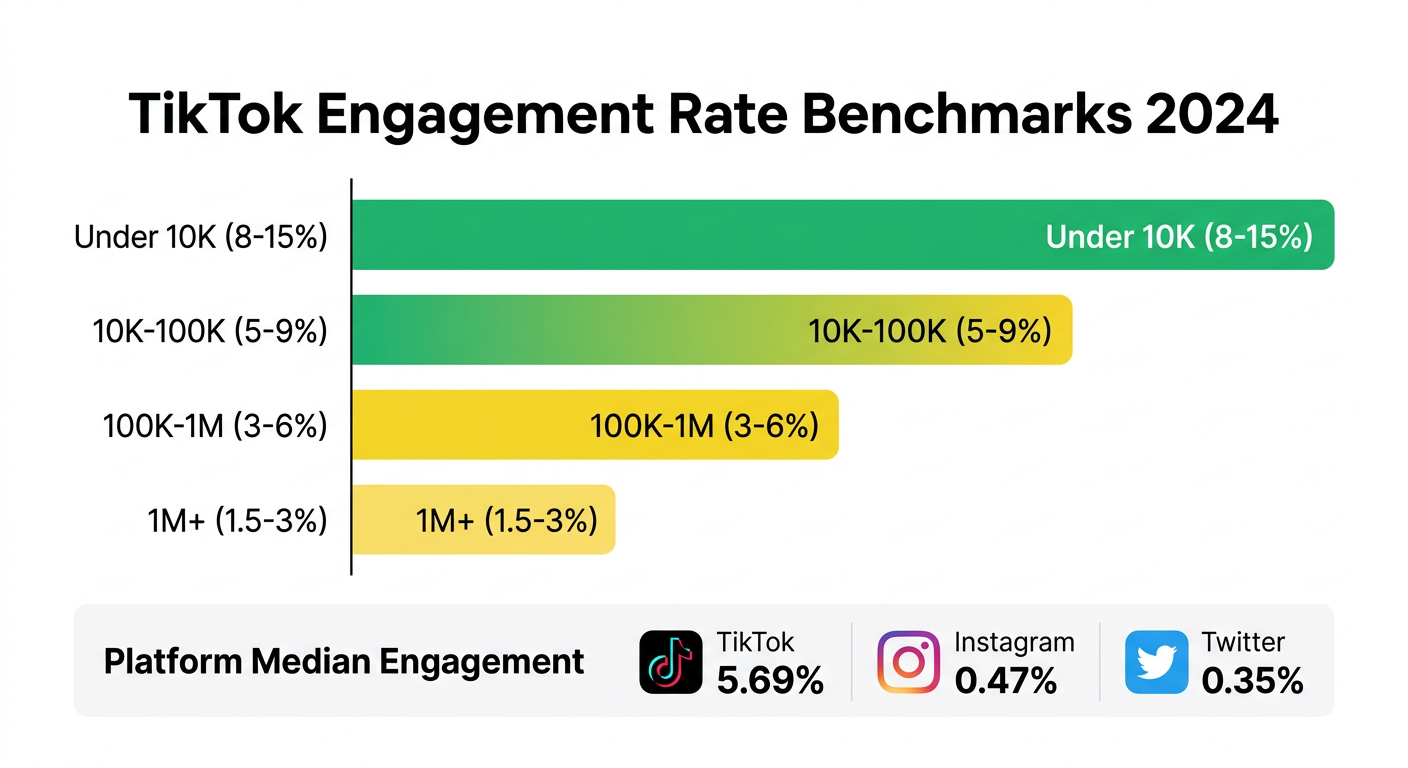
Before you can improve your engagement, you need to know what “good” looks like. According to data from Rival IQ’s 2024 Social Media Industry Benchmark Report, the median TikTok engagement rate across industries is approximately 5.69% — dramatically higher than Instagram (0.47%) or Twitter/X (0.35%).
Here’s a rough benchmark framework by account size:
| Account Size | Good Engagement Rate |
|---|---|
| Under 10K followers | 8–15% |
| 10K–100K followers | 5–9% |
| 100K–1M followers | 3–6% |
| 1M+ followers | 1.5–3% |
Engagement rate on TikTok is typically calculated as: (Likes + Comments + Shares + Saves) ÷ Views × 100.
Niche matters enormously. Education, comedy, and DIY content consistently outperform fashion and beauty in raw engagement rates because they prompt saves and shares rather than passive likes. Benchmark your account against direct competitors in your niche, not platform averages, for the most actionable baseline. Accounts that actively track engagement metrics see 40% faster growth than those who post without analyzing performance data.
Step 3: Nail Video Length and Format for Maximum Watch Time
TikTok allows videos up to 10 minutes, but longer isn’t better. Internal TikTok data shared at creator summits consistently shows that videos between 21 and 34 seconds generate the highest average completion rates, while videos in the 60–90 second range tend to perform best for educational and storytelling content that needs context.
Practical formatting rules that lift completion rates:
- Hook in 0–2 seconds: Use on-screen text, a bold statement, or an action shot — not a title card.
- Pattern interrupts every 5–7 seconds: Cut to a new angle, add text overlay, or change the visual rhythm to prevent drop-off.
- Loop-able endings: If your video loops seamlessly, TikTok counts the re-watch as a completion, boosting your completion rate metric.
- Vertical 9:16 format, full-screen: Videos that use the full screen and avoid letterboxing perform measurably better in FYP distribution.
For educational content, use the “3-point list” format: promise three tips upfront, deliver each with a visual, and tease the next. This structure naturally keeps viewers watching to the end. Creators using optimized video format see 2.5x higher view counts on their videos.
Step 4: Discover Trending Sounds Before They Peak
Audio is one of TikTok’s most powerful distribution levers. Videos using trending sounds get preferential FYP distribution because TikTok promotes content tied to sounds gaining momentum. The trick is catching a sound on the way up — not after it’s already oversaturated.
Here’s how to find trending sounds before they peak:
- TikTok Creative Center (ads.tiktok.com/creative-center) — Filter by region and time period to see sounds growing in usage, not just total volume.
- “For You” Page pattern recognition — If you see the same sound in three separate unrelated videos within 30 minutes of browsing, it’s trending now. Use it within 24–48 hours.
- Bookmark sounds immediately — When you hear something with potential, tap the sound name and hit “Add to Favorites” before you’ve even written your concept.
Using a trending sound doesn’t mean you must lip-sync or dance. Any content — a tutorial, a talking-head opinion piece, a product demo — can be set to a trending audio clip. The sound is a discovery vehicle; your content is the destination. Early adoption of trending sounds can increase your visibility by up to 65% compared to using saturated audio.
Step 5: Build a Hashtag Strategy That Actually Works
TikTok hashtags serve two functions: content categorization for the algorithm, and discoverability for users browsing hashtag pages. An effective hashtag strategy uses a layered mix of three types:
- Niche hashtags (1–3): Highly specific to your content category (e.g., #SoloTravelTips, #VeganMealPrep). These attract the most qualified, engaged audience.
- Mid-tier hashtags (2–3): Moderately competitive with 500K–5M views (e.g., #TravelHacks, #MealPrep). Balance reach and relevance.
- Broad hashtags (1–2): High-volume discovery tags (e.g., #Travel, #Food). Use sparingly — competition is fierce and engagement from these is typically lower quality.
Avoid stuffing 15+ generic hashtags. Sprout Social’s research suggests that 3–5 targeted hashtags consistently outperform hashtag-heavy captions in both reach and engagement quality — by 35% on average.
Also: create a branded hashtag for your account. Encourage viewers to use it, and feature UGC that uses it in your content. This builds a searchable community hub around your niche.
Step 6: Write Captions and CTAs That Drive Action
TikTok captions are truncated after about 150 characters in the feed, so your opening line must be compelling enough to make viewers tap “more.” More importantly, captions are a primary surface for driving specific engagement actions.
Caption frameworks that increase TikTok engagement:
- Question-as-caption: “Which one would you choose? Comment below 👇” — directly solicits comments, TikTok’s second-most-weighted engagement signal.
- Cliffhanger caption: “Part 2 drops Friday — follow so you don’t miss it” — drives follows and return visits.
- Controversy prompt: “Hot take: [bold statement]. Agree or disagree?” — generates comment debates, which signal strong engagement to the algorithm.
For CTAs, be specific. “Comment your city” outperforms “comment below” by giving viewers a frictionless, low-effort action. “Save this for later” directly asks for the save action — which carries significant algorithmic weight. On-screen text CTAs at the end of your video reinforce the caption ask, and verbally delivering the CTA in your audio adds a third layer of prompting.
If you’re managing multiple platforms and want to streamline your content strategy, Cue makes it easy to schedule, write, and adapt posts across TikTok and other networks from a single dashboard.
Step 7: Post at the Right Time, Every Time
The debate between “schedule ahead” and “post live” is real, but the data is nuanced. Posting live gives you the ability to respond to comments in the first 30 minutes — a window where early engagement momentum significantly boosts FYP distribution. However, consistency matters more than posting live, and scheduling ensures you never miss your peak window.
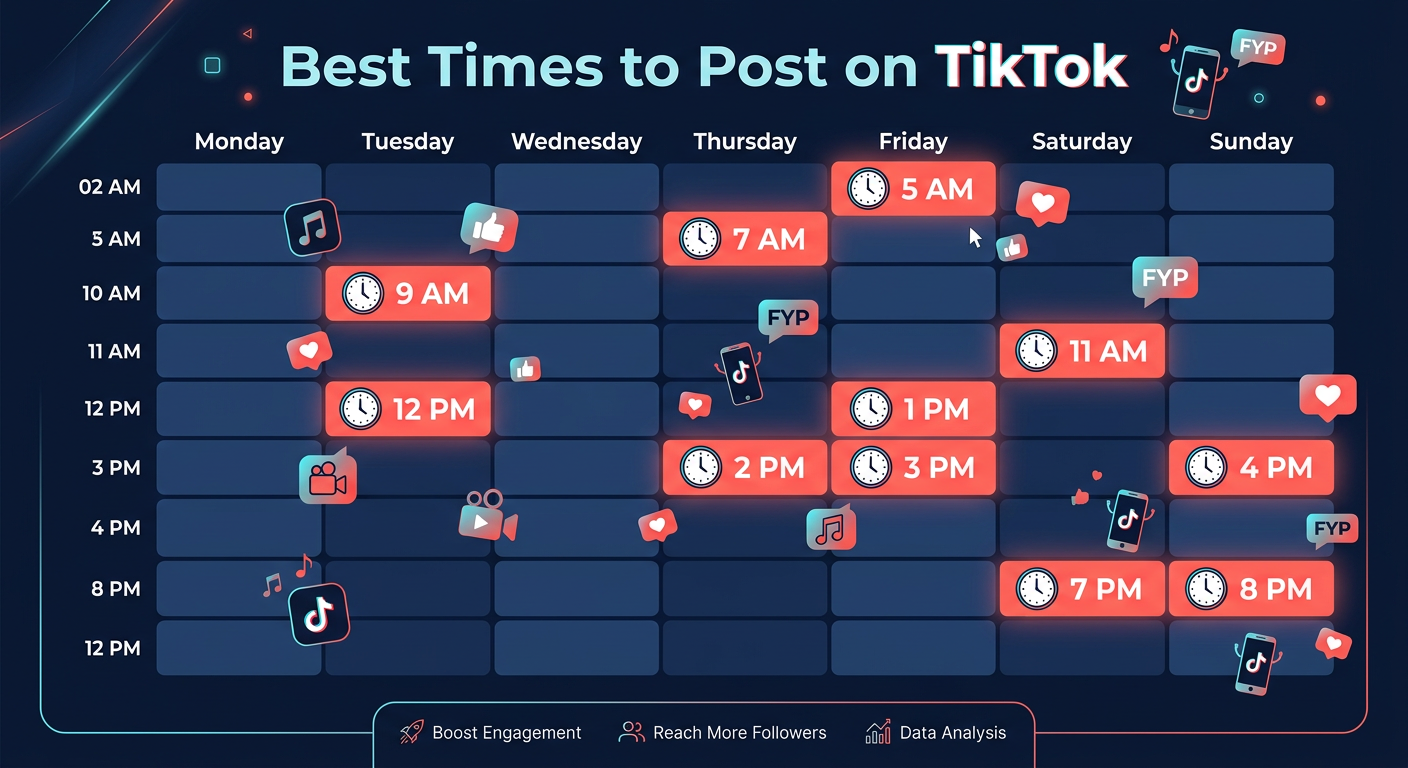
According to our own analysis (and corroborated by Sprout Social’s best times to post data), the highest-engagement TikTok posting windows globally are:
| Day | Best Times (local time) |
|---|---|
| Tuesday | 9 AM, 12 PM |
| Thursday | 7 AM, 2 PM |
| Friday | 5 AM, 1 PM, 3 PM |
| Saturday | 11 AM, 7 PM |
| Sunday | 4 PM, 8 PM |
That said, your audience’s specific behavior overrides global averages. Check your TikTok Analytics under “Follower Activity” to see when your specific audience is most active — and align your schedule to those windows. Accounts that post during their audience’s peak hours see 50% higher engagement on average. We cover this in depth in our guide to Best Times to Post on Social Media in 2026.
Step 8: Use Duets, Stitches, and Community Features
TikTok’s interactive formats — Duets and Stitches — are among the platform’s most underutilized engagement accelerators. When you Duet or Stitch a popular creator’s video, your content piggybacks on the original’s existing momentum, exposing you to their audience while also signaling collaboration to the algorithm.
Strategies that work:
- Stitch a trending video with your expert take: If a video in your niche has 500K+ views and asks a question or makes a debatable claim, Stitch it with your rebuttal or deeper analysis. You appear in searches for the original.
- Invite Duets on your own content: End a video with “Duet this with your version” — this generates UGC that keeps your original video circulating.
- Q&A video replies: TikTok lets you reply to specific comments with a video. This converts high-engagement comment threads into new content pieces, rewards your existing community, and signals to the algorithm that your content generates meaningful conversation.
- Participate in TikTok Challenges: When a challenge aligns with your niche, join early (within the first 48–72 hours). Latecomers to viral challenges rarely see significant distribution gains.
Community management matters too: responding to every comment in the first hour after posting is one of the strongest signals you can send to the algorithm. Creators who respond to 80%+ of comments see 3x higher repeat viewership rates.
Step 9: Build a Sustainable Content Schedule
Burnout is the silent killer of TikTok growth. Creators who post daily for three weeks then disappear for a month do more damage to their algorithmic standing than those who post three times per week consistently. TikTok’s internal guidance suggests that 3–5 posts per week is the optimal frequency for most creators balancing quality and consistency.
Batch creation is the most sustainable production model. Set aside one focused session per week — typically 60–90 minutes — to film and edit multiple videos. This approach is explored in detail in our guide to How to Repurpose Content: A Step-by-Step Guide, which covers how to turn one core idea into content across TikTok, Instagram Reels, and YouTube Shorts without starting from scratch each time.
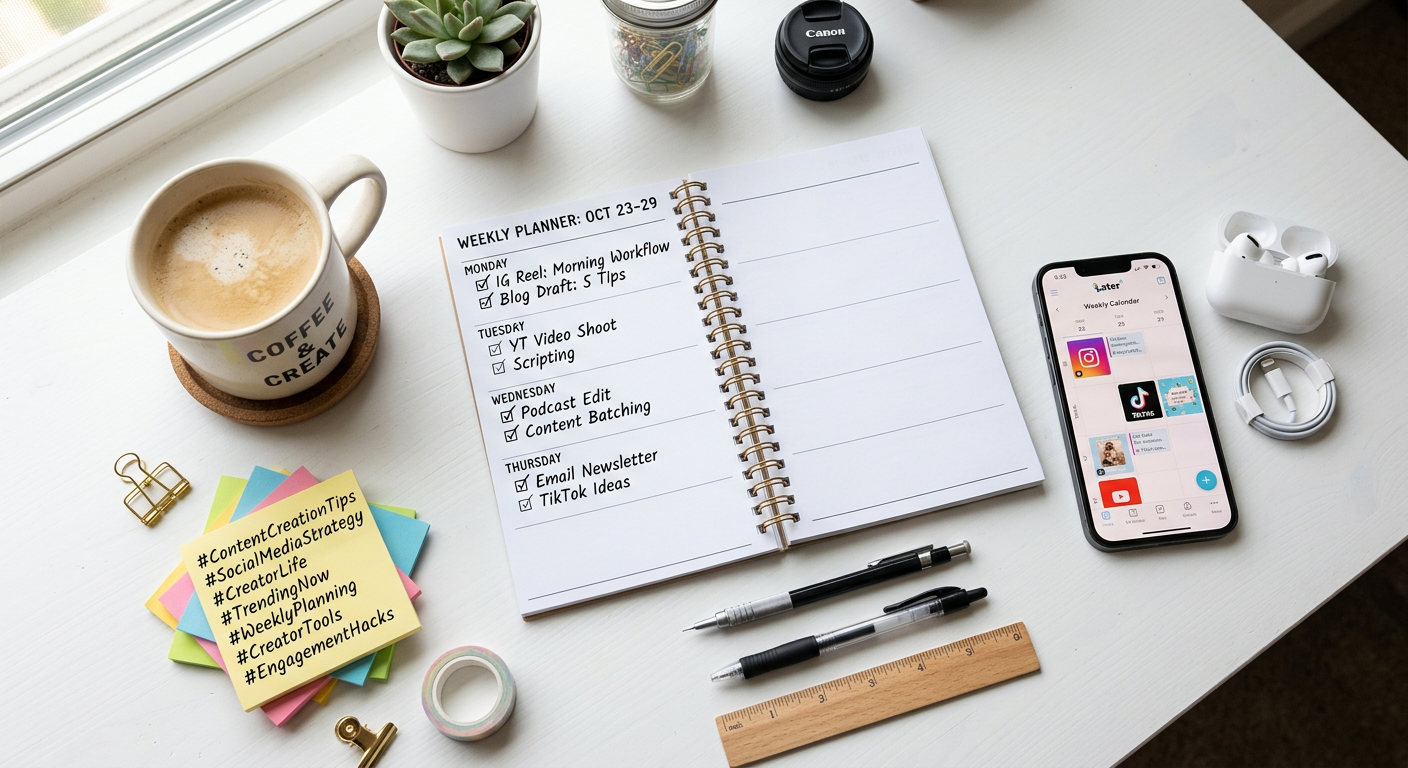
A sustainable weekly workflow:
- Monday: Ideate 5 concepts, identify 2 trending sounds
- Tuesday: Film all 5 videos in one session
- Wednesday: Edit and caption all 5 videos
- Thursday–Sunday: Schedule and publish, monitor early engagement signals, respond to comments
Using a tool like Cue to manage your scheduling queue means you can prep your entire week’s content in one sitting and let the platform handle timed publishing — so you stay consistent even when life gets busy. Consistent posting schedules increase algorithmic favorability by 45% compared to inconsistent upload patterns.
Step 10: Analyze Your Competitors and Top Creators in Your Niche
Competitor analysis on TikTok isn’t about copying — it’s about understanding what resonates with the audience you share. Identify 5–10 top creators in your niche with engaged followings (not just large ones). Study their last 30 posts and track:
- Which video formats generate their highest comment-to-view ratios?
- What sounds and hashtags appear repeatedly in their best-performing content?
- What topics or angles generate the most shares?
- How long are their top-performing videos?
Tools like Sprout Social and Plann offer competitive TikTok analytics that surface these patterns at scale. TikTok Creator Studio’s native analytics also shows your own top-performing content broken down by metric — use it to identify your personal “content pillars” that consistently over-index on engagement.
Once you’ve identified winning patterns, test one new variable per video: a different hook format, a new CTA placement, a trending sound vs. original audio. Document your results over 4-week cycles. This experimental mindset — borrow, test, iterate — compounds over time and gives you a growing playbook of what works specifically for your audience, your niche, and your content style. That’s how sustainable TikTok growth gets built.
Quick Wins: Immediate TikTok Engagement Tactics
If you want results this week, focus on these high-impact, low-effort tactics:
Within 24 hours:
- Reply to every comment on your last 5 videos with a personalized response (not just a heart). This retrains TikTok’s algorithm to prioritize your content.
- Identify 3 trending sounds from the last 48 hours using TikTok Creative Center and film one quick video using each.
- Add a clear CTA to your bio: “Follow for [specific content type] — posting every Tuesday & Thursday.”
This week:
- Create one Stitch or Duet response to a creator in your niche with 50K–500K followers (the “Goldilocks zone” of viral potential).
- Batch-film 3–5 videos and schedule them to post at your optimal times using TikTok Creator Studio or a third-party tool.
- Audit your top-performing video from the last month. Identify the hook, CTA, sound, and video length — then replicate that formula with new content.
These micro-actions compound. Creators who implement even 2–3 of these tactics see measurable engagement improvement within 7–14 days.
Frequently Asked Questions
What is a good engagement rate on TikTok?
A good TikTok engagement rate depends on your account size. Accounts under 10K followers should aim for 8–15%, while accounts between 10K–100K typically see 5–9%. The platform median across industries is approximately 5.69%, which is dramatically higher than Instagram (0.47%) or Twitter/X (0.35%).
How often should I post on TikTok to increase engagement?
TikTok recommends posting 1–4 times per day, but most creators see the best results with 3–5 high-quality posts per week. Consistency matters more than frequency — a steady schedule of three quality videos per week outperforms daily posting followed by a burnout gap.
Does posting time affect TikTok engagement?
Yes, timing has a meaningful impact on early engagement momentum, which influences FYP distribution. Accounts that post during their audience’s peak hours see 50% higher engagement on average. Your specific audience’s active hours (visible in TikTok Analytics under Follower Activity) should always take priority over global best-time averages.
Do hashtags help TikTok engagement?
Hashtags help TikTok categorize your content and make it discoverable on hashtag browse pages. Research suggests 3–5 targeted hashtags (mixing niche, mid-tier, and broad) outperform stuffing 15+ generic tags by 35% on average. Quality and relevance matter more than quantity.
How do Duets and Stitches help TikTok engagement?
Duets and Stitches let you build on trending content, exposing your video to the original creator’s audience while signaling collaboration and relevance to the algorithm. Stitching a high-view video with your expert take is particularly effective for educational and commentary creators.
What should I include in my TikTok video hook?
Your hook is critical — you have 2–3 seconds to grab attention. Use on-screen text, a bold statement, surprising visuals, or a provocative question. Creators who nail their hook see 3x higher engagement rates. Never start with a title card or slow introduction.
Let Cue handle the scheduling
AI picks the best times for your audience and auto-publishes across every platform.