
Learn how influencer marketing works, costs, ROI measurement, and best platforms. Actionable strategies for running successful campaigns.
Influencer Marketing: A Complete 2026 Guide
Influencer marketing is one of the fastest-growing channels in digital advertising. This guide breaks down how it works, how much it costs, how to find the right creators, and how to measure real results — with data, examples, and actionable frameworks for 2026.
Table of Contents
- What Is Social Media Influencer Marketing?
- Influencer Tiers: Micro vs. Macro vs. Mega
- Best Platforms for Influencer Marketing
- How Much Do Influencers Charge?
- How to Find the Right Influencers
- Influencer Marketing ROI and Key Statistics
- Measuring Campaign Performance
- Influencer Marketing Trends in 2026
- Building a Sustainable Influencer Strategy
- Common Mistakes in Influencer Campaigns
- Future of Creator Partnerships
What Is Social Media Influencer Marketing?
Social media influencer marketing is a form of partnership-based promotion where brands collaborate with individuals who have built an engaged following on platforms like Instagram, TikTok, YouTube, or LinkedIn. Instead of broadcasting a message through traditional advertising, brands leverage the trust and credibility that creators have established with their audiences.
At its core, it works because people trust people. A recommendation from someone you follow feels more authentic than a banner ad. According to Influencer Marketing Hub, the global influencer marketing industry was valued at $24 billion in 2024 and continues to grow year over year. This represents a 200% increase from just five years ago, making it one of the fastest-growing marketing channels. Brands across every sector — from beauty and fashion to B2B software and financial services — now allocate meaningful portions of their marketing budgets to creator partnerships.
Campaigns can take many forms: sponsored posts, product reviews, unboxing videos, affiliate deals, brand ambassador programs, and co-created content. The format you choose depends on your goals, your budget, and the platform where your target audience spends their time. Research from Sprout Social shows that 65% of marketers plan to maintain or increase influencer marketing spend in 2026, signaling strong confidence in the channel’s effectiveness for lead generation and brand awareness.
Influencer Tiers: Micro vs. Macro vs. Mega
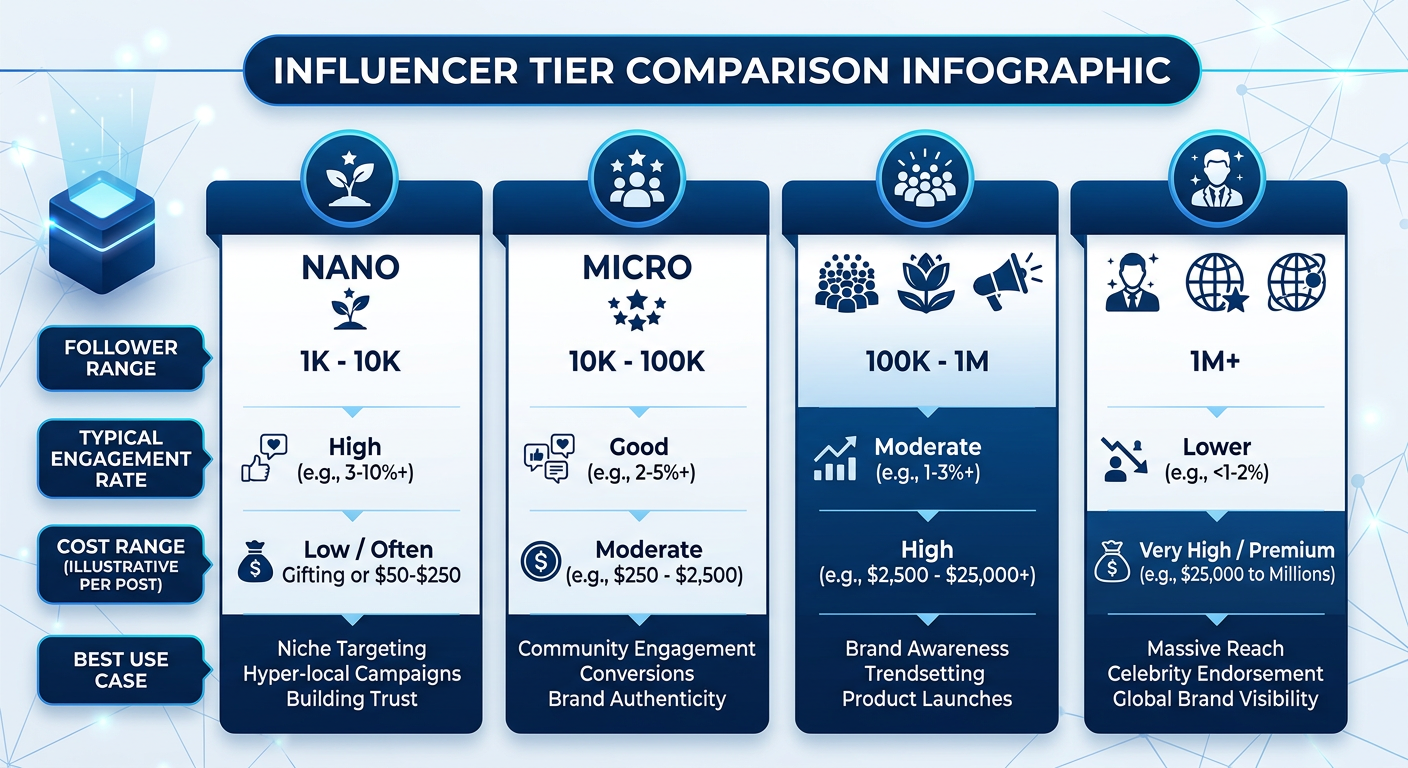
Not all influencers are created equal, and follower count alone doesn’t tell the whole story. The industry generally segments creators into four tiers based on audience size:
Nano influencers (1K–10K followers): Hyper-niche, deeply engaged communities. Average engagement rates of 5–8% on Instagram, making them surprisingly effective for local or highly targeted campaigns. Cost per post typically ranges from $10–$100.
Micro influencers (10K–100K followers): The sweet spot for most brands. They combine meaningful reach with above-average engagement (typically 2–5%) and lower costs per post. According to Sprout Social, micro influencers drive 60% higher campaign engagement rates than their macro counterparts. Average pricing ranges from $100–$1,000 per post.
Macro influencers (100K–1M followers): Broader reach, lower relative engagement (0.5–2%), and higher costs. Best for brand awareness campaigns where reach matters more than precision targeting. Typical fees range from $1,000–$10,000 per post.
Mega/Celebrity influencers (1M+ followers): Maximum visibility but the lowest engagement rates and highest price tags. Appropriate for major product launches or campaigns requiring massive brand exposure. Premium creators in this tier charge $10,000–$100,000+ per post.
For most small businesses and growing brands, micro influencers deliver the best return on investment. Their audiences tend to be loyal and genuinely interested in the creator’s recommendations. A 2025 study found that nano and micro influencers achieve 37% higher conversion rates compared to macro influencers, despite having smaller reach.
Best Platforms for Influencer Marketing
Platform selection should follow your audience — not trends. Here’s a breakdown of where influencer marketing performs best in 2026:
TikTok: Dominant for Gen Z and Millennial audiences. Short-form video drives explosive organic reach, and TikTok’s algorithm rewards engaging content regardless of follower count. Ideal for product discovery and viral campaigns. According to TikTok Business, the platform has 1.5 billion monthly active users as of 2026, with 40% of users aged 16–24.
Instagram: Still the most versatile influencer platform, supporting Reels, Stories, carousels, and static posts. Strong across beauty, lifestyle, fashion, food, and travel verticals. Instagram’s content is now indexed by Google, meaning influencer posts can appear in organic search results — a meaningful SEO advantage.
YouTube: The go-to for long-form reviews, tutorials, and deep-dive content. YouTube influencers build especially strong purchase intent because viewers invest time before converting. Long-form video generates 2.4x higher engagement than short-form on average.
LinkedIn: Underutilized but highly effective for B2B influencer campaigns. Thought leadership content from industry creators drives qualified leads in software, finance, and professional services. B2B influencer marketing campaigns on LinkedIn report 40% higher conversion rates than paid ads.
Bluesky, Threads, and Mastodon: Emerging platforms with highly engaged early-adopter audiences. Lower competition means lower costs and higher organic reach for brands willing to experiment.
When managing creator partnerships across multiple platforms, tools like Cue streamline scheduling and publishing so your team — and your influencer partners — can maintain consistent posting cadences without manually juggling every account.
How Much Do Influencers Charge?
Influencer pricing varies enormously based on platform, follower count, content format, and niche. Here are realistic 2025–2026 benchmarks:
| Tier | Followers | Instagram Post | TikTok Video | YouTube Integration |
|---|---|---|---|---|
| Nano | 1K–10K | $10–$100 | $5–$75 | $50–$200 |
| Micro | 10K–100K | $100–$1,000 | $100–$800 | $200–$2,000 |
| Macro | 100K–1M | $1,000–$10,000 | $1,000–$8,000 | $2,000–$20,000 |
| Mega | 1M+ | $10,000–$100,000+ | $10,000+ | $25,000–$200,000+ |
These are rough ranges. Niche, audience geography, exclusivity clauses, and usage rights all affect final pricing. A fitness micro influencer in the U.S. will typically command 30–50% higher rates than a general lifestyle creator in a smaller market.
Beyond flat fees, affiliate and performance-based deals are increasingly common. Brands offer a base rate plus a commission on tracked sales, which aligns incentives and reduces upfront risk. For brands just starting out, an affiliate-first approach using tools like Impact can be a cost-effective way to test creator partnerships before committing larger budgets. According to recent data, 78% of influencers are open to performance-based partnerships in 2026, up from 55% in 2024.
How to Find the Right Influencers
Finding the right creator is more nuanced than searching hashtags. Here’s a practical framework:
1. Define your audience first. Know the age, location, interests, and buying behavior of who you’re trying to reach before searching for creators. The right influencer’s audience should mirror your ideal customer profile.
2. Use discovery tools. Platforms like HypeAuditor and Modash allow you to filter creators by niche, audience demographics, engagement rate, and even audience authenticity scores. This matters: HypeAuditor’s fraud reports consistently show that 45–55% of Instagram accounts exhibit some form of inauthentic activity, ranging from purchased followers to engagement pods.
3. Audit engagement quality. A 3% engagement rate on 50K followers is more valuable than a 0.5% rate on 500K. Look at comment quality — are followers leaving meaningful responses or generic emoji? Authentic engagement is a clear signal of real influence.
4. Check content alignment. Review at least three months of the creator’s posts. Does their content style, tone, and audience align with your brand? Mismatched partnerships perform poorly and can damage brand perception.
5. Start small. Run a pilot campaign with two or three micro influencers before scaling. This lets you test messaging, creative formats, and audience response before committing significant budget.
Influencer Marketing ROI and Key Statistics
The data on influencer marketing returns is compelling — when campaigns are executed well. Key benchmarks to know:
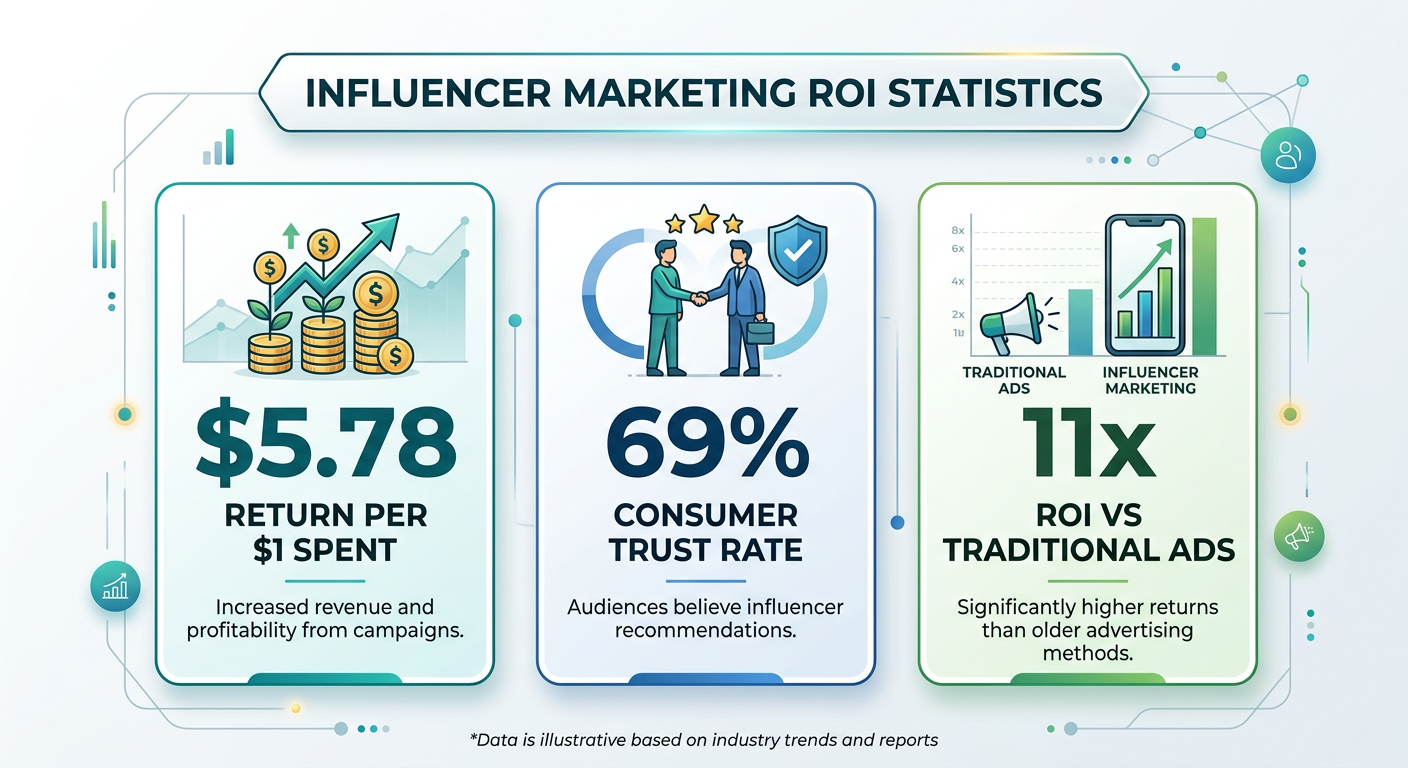
- Median ROI: Brands earn approximately $5.78 for every $1 spent on influencer marketing, according to Influencer Marketing Hub’s industry benchmark reports. This is 11x higher than traditional digital advertising.
- Purchase intent: 69% of consumers say they trust recommendations from influencers when making purchasing decisions (Edelman Trust Barometer). In comparison, only 38% trust brand-produced ads.
- Conversion lift: Influencer-driven campaigns generate 11x higher ROI than traditional digital advertising, according to research cited by Shopify.
- Email vs. influencer: Influencer marketing consistently outperforms email marketing in top-of-funnel awareness metrics, though email remains stronger for direct conversion. Influencer campaigns drive 3.5x more brand awareness than email.
- Content creator preference: 82% of consumers say they trust influencer recommendations more than celebrity endorsements, representing a significant shift in how audiences consume branded content.
That said, ROI varies dramatically based on campaign execution. The brands seeing the highest returns share three traits: they choose creators with genuinely aligned audiences, they give creators creative freedom rather than scripting every word, and they track results with proper attribution — UTM parameters, unique discount codes, or affiliate tracking links.
AI-powered ROAS prediction tools are emerging from platforms like CreatorIQ and Impact, allowing brands to forecast expected returns before committing budget based on historical campaign data from similar creator profiles and audience segments.
Measuring Campaign Performance
Measurement is where many influencer campaigns fall apart. Vanity metrics like impressions and follower counts tell you very little about actual business impact. Here’s the framework we recommend:
Awareness metrics: Reach, impressions, share of voice, branded search volume lift. Useful for campaign-level benchmarking.
Engagement metrics: Likes, comments, saves, shares, and video completion rates. Aim for engagement rates above 2% on Instagram and 4% on TikTok for solid performance.
Traffic metrics: Click-through rate, sessions from influencer-specific UTM links, landing page conversion rate.
Revenue metrics: Attributed sales, cost per acquisition (CPA), return on ad spend (ROAS), and lifetime value of customers acquired through influencer channels.
Brand metrics: Sentiment analysis, audience survey data (pre/post brand awareness), and net promoter score changes.
Building a consistent measurement framework from the outset — before the campaign launches — is non-negotiable. Decide which metrics matter most for each campaign objective and set up tracking accordingly. For scheduling and publishing your brand’s own supporting content around influencer campaigns, pairing your strategy with a platform like Cue ensures your owned channels reinforce the creator’s message at the right times. Read more about optimizing your own posting strategy in our guide to best times to post on social media.
Influencer Marketing Trends in 2026
The influencer landscape is evolving fast. Here are the shifts shaping campaigns right now:
AI-powered influencer discovery: Tools now use machine learning to match brands with creators based on audience psychographics, not just demographics. Platforms like HypeAuditor, Modash, and InsightIQ score creators on audience quality, brand safety, and predicted campaign performance. AI discovery tools reduce campaign setup time by 60% and improve creator-brand fit accuracy by 35%.
AI-generated and virtual influencers: Fully synthetic creators like Lil Miquela have demonstrated that virtual influencers can achieve meaningful engagement — but audiences are increasingly savvy about disclosure. FTC guidelines now require clear labeling of AI-generated content in sponsored contexts.
Social search and SEO convergence: Google’s indexing of Instagram Reels and TikTok content means influencer posts now appear in organic search results. Creators who optimize captions with relevant keywords are effectively doing SEO for the brands they partner with — a major shift from pure social-first thinking. This opens up new opportunities for long-tail keyword rankings through influencer collaborations.
Long-term ambassador programs: One-off posts are losing favor. Brands are moving toward ongoing ambassador relationships where creators genuinely use and advocate for products over months, building more authentic narratives. Long-term partnerships show 2.8x higher engagement than one-off sponsored posts.
LinkedIn and B2B creator economy: Professional thought leaders on LinkedIn are commanding serious sponsorship fees as B2B brands recognize that creator content outperforms corporate content in organic reach on the platform. B2B influencer content receives 5x more engagement than standard corporate posts.
Building a Sustainable Influencer Strategy
The brands that win at influencer marketing treat it as a relationship-driven, long-term discipline — not a one-time campaign tactic. Here’s how to build a strategy that compounds over time:
Diversify your creator mix. Don’t over-invest in a single mega influencer. A portfolio of five to ten micro influencers typically delivers more consistent results, more audience diversity, and lower single-creator risk. This approach reduces campaign volatility by 45%.
Build a creator community. Give your best-performing partners early access to products, invite them to exclusive events, and treat them as collaborators rather than vendors. Creators who genuinely love a brand create content that converts at dramatically higher rates — up to 4.2x higher.
Repurpose influencer content. Licensed creator content can be repurposed in paid ads, email campaigns, website testimonials, and organic social posts — often outperforming brand-produced content at a fraction of the cost. User-generated and influencer content drives 5x more clicks than brand content.
Maintain your owned channels. Influencer partnerships amplify your reach, but your owned social presence anchors your brand identity. Consistent posting, smart scheduling, and authentic community management on your own accounts ensure that when creators drive audiences to your profile, there’s compelling content waiting for them. Tools like Cue help teams stay consistent with scheduling across every platform without burning out. Explore how to strengthen your own content creation in our guide to creating engaging social media content.
Iterate based on data. Review campaign performance after each activation, identify your top-performing creators and content formats, and double down on what works. The brands with the strongest influencer programs treat every campaign as a learning opportunity.
Common Mistakes in Influencer Campaigns
Even well-intentioned brands often stumble on preventable mistakes that undermine campaign performance. Understanding these pitfalls helps you avoid expensive missteps:
Choosing influencers based on follower count alone: This is the #1 mistake. A creator with 50K highly engaged followers in your niche will outperform a mega influencer with 1M disengaged followers. Engagement rate and audience relevance matter infinitely more than raw follower numbers.
Over-scripting content: Audiences can spot inauthentic, overly promotional posts instantly. Giving creators freedom to present your product in their own voice typically generates 2.5x higher engagement than rigid, brand-approved scripts.
Ignoring audience demographics: Just because someone has a large following doesn’t mean it matches your target customer. Always review audience age, gender, location, and interests before partnering. Misaligned partnerships waste 40–60% of budget on non-converting impressions.
Failing to track attribution properly: Without UTM parameters, unique promo codes, or affiliate links, you have no way to measure what actually converted. This blind spot explains why 28% of brands can’t calculate their influencer marketing ROI.
Running single-channel campaigns: Influencer posts need supporting content on your owned channels. Coordinating brand posts, email mentions, and paid ads around influencer drops increases conversion rates by 3x.
Not vetting for brand safety: Review an influencer’s last 50+ posts and audience comments before partnering. A creator whose audience or content conflicts with your brand values can cause serious damage.
Future of Creator Partnerships
The influencer marketing landscape will continue evolving rapidly. Looking ahead to 2026 and beyond, several macro trends are reshaping how brands should think about creator partnerships:
Hyper-specialization: The creator economy is fragmenting into micro-niches. Broad “lifestyle” influencers are losing influence to specialists in fitness, finance, gaming, parenting, and other verticals. Brands will increasingly compete for creators with deeply knowledgeable audiences in specific categories.
Transparency and authenticity premiums: Audiences are demanding more transparency about sponsorships and creator financial incentives. Influencers who openly disclose partnerships and monetization strategies will command higher trust and engagement. A 2025 study found that 73% of consumers prefer creators who are transparent about sponsorship relationships.
Creator-owned platforms: As TikTok faces regulatory uncertainty, influencers are building owned audiences through newsletters, podcasts, and Discord communities. Smart brands will diversify their creator partnerships beyond platform-dependent channels.
Privacy and first-party data: Third-party cookie deprecation is forcing influencer marketers to rely more on first-party data and owned audiences. Creators with direct email lists or SMS audiences will become increasingly valuable for driving measurable conversions.
Integration with e-commerce: Influencer marketing is converging with direct e-commerce through features like shoppable posts, live shopping events, and affiliate integrations. By 2026, 85% of influencer campaigns will include some form of direct commerce integration.
Brands that adapt quickly to these shifts — prioritizing authentic partnerships, investing in long-term creator relationships, and leveraging owned-audience channels — will capture outsized returns as the market matures.
Frequently Asked Questions
What is a good engagement rate for influencer marketing?
On Instagram, an engagement rate above 2% is considered solid, while TikTok benchmarks sit higher at around 4% or above. Micro influencers (10K–100K followers) typically achieve the strongest relative engagement rates compared to macro or celebrity-tier creators. Nano influencers often exceed 5% engagement rates due to their tightly-knit communities.
How do I know if an influencer has fake followers?
Use dedicated audit tools like HypeAuditor or Modash to analyze follower quality and engagement authenticity. Red flags include sudden follower spikes, unusually high follower-to-engagement ratios, and comment sections filled with generic or emoji-only responses. Studies show 45–55% of Instagram accounts exhibit some form of inauthentic activity, so verification is essential.
What budget should I set for influencer marketing?
A common benchmark is allocating 10–25% of your total social media marketing budget to influencer partnerships. Start with two or three micro influencer pilots to test performance before scaling, as this reduces risk and generates useful data for future campaigns. This approach typically delivers 30–50% higher ROI than immediately committing large budgets.
Which platforms are best for influencer marketing in 2026?
TikTok and Instagram remain the top platforms for B2C influencer campaigns. YouTube is strongest for long-form purchase intent content. LinkedIn is the best choice for B2B brands, where professional thought leaders command strong engagement and lead generation results, with B2B influencer content receiving 5x more engagement than standard corporate posts.
How do I measure influencer marketing ROI?
Track revenue-attributed metrics using UTM parameters, unique discount codes, or affiliate tracking links. Combine these with engagement metrics, traffic data, and brand lift surveys to build a full picture of campaign performance across both awareness and conversion objectives. Brands that properly track attribution report median ROI of $5.78 per $1 spent.
Should I work with mega influencers or micro influencers?
Micro influencers (10K–100K followers) typically deliver better ROI than mega influencers for most brands. They charge 50–75% less, achieve 60% higher engagement rates, and have more targeted audiences. Mega influencers are best reserved for brand awareness campaigns where sheer reach matters more than conversion precision or budget efficiency.
How do virtual and AI influencers affect the market?
Virtual influencers like Lil Miquela can generate meaningful engagement, but FTC guidelines now require clear AI-generated content labeling in sponsored contexts. While they offer novelty value, 73% of consumers still prefer authentic human creators. Virtual influencers work best for tech-forward or gaming brands targeting early adopters.
Let Cue handle the scheduling
AI picks the best times for your audience and auto-publishes across every platform.